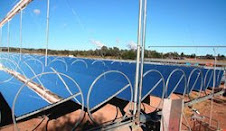
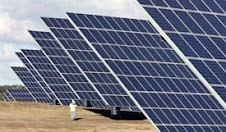
Taiwanese, Korean cos to set up $400-mn solar panel unit
artcile from http://economictimes.indiatimes.com
29 Oct, 2007, 0047 hrs IST, TNN
KOLKATA: An eight-member team from South Korea, Taiwan and Singapore and officials from Kolkata-based Synergy Renewable Energy (SREPL) on Friday met West Bengal’s chief minister Buddhadeb Bhattacharya and formalised an agreement to set up a $400-million joint venture project to manufacture solar wafer at Durgapur in West Bengal.
Solar wafers are used to manufacture solar panels and modules which go into generating electricity from sunlight. Under the agreement, a company christened Kits Solar, will be incorporated and registered in Kolkata with an authorised share capital of Rs 200 crore. It will be an 100% export-oriented unit.
The West Bengal government has decided to pick up 10% equity through the West Bengal Renewable Energy Development Agency in the project, which will become operational in the next one year.
SREPL will hold 30% while South Korea’s Komex along with its associates from Singapore, Taiwan and South Korea will hold the remaining 60% stake in the company. The Komex-led consortium members include Green Energy Technology of Taiwan, Glosil of South Korea, Smart Applications of South Korea, S&T Solar Pte of Singapore, Rectec International and Motech of Taiwan.
This will be the first wafer manufacturing facility in India and will also mark the entry of Korean and Taiwanese majors in the field of solar energy in India.
Showing posts with label asia clean energy. Show all posts
Showing posts with label asia clean energy. Show all posts
Sunday, December 02, 2007


Sunday, November 18, 2007
Branson plans on being aviation's clean fuel pioneer
Virgin founder Richard Branson – a true philanthropist – shares philosophy on giving, hosts charity gala, promotes ecologival ventures
Sandro Contenta, Feature Writer, TheStar.com
Richard Branson insists there's method to his madness.
Sure, he has crash-landed hot air balloons and jumped off a 40-storey building – all in the name of publicizing his Virgin Group business empire. But he says the self-described "mad escapades" have helped amass the kind of phenomenal wealth needed to make a positive difference worldwide.
"If capitalism is not going to be given a bad name, it's up to successful capitalists to make sure that they use that wealth constructively," Branson said in an interview yesterday.
At 57, Branson is turning his thoughts to a legacy beyond having built the largest group of private companies in Europe. Like Bill Gates and Warren Buffett, two of the world's richest men, Branson has decided to focus part of his energy and fortune on philanthropy.
Last night, he hosted a fundraising gala in Toronto for his charitable organization, Virgin Unite, which helps local groups battle challenges such as poverty, access to health care and global warming. Funds from the event went to support a project dubbed Heaven's Angels. It provides motorcycles to African caregivers, helping them reach communities that are difficult to access.
Another initiative is to set up a "war room" in South Africa to examine hundreds of non-governmental projects across Africa to determine and publicize "best practices," such as the best way to fight malaria.
But the British entrepreneur couldn't help mixing business with philanthropy.
Earlier in the day, he used high-profile magician Criss Angel – in town mainly to perform at the gala – to promote Virgin Mobile's entry next year in the contract-based cellphone business.
Indeed, Branson makes clear that what's good for the environment and social justice is also good for business.
"For customers who come into contact with Virgin, they will view Virgin better if we're using our resources in a positive way than a negative way," he said.
The swashbuckling entrepreneur's rise to riches has been well documented. A dyslexic who dropped out of high school at 16, he launched a magazine for young people that sold 75,000 copies an issue.
He used the money to set up a record company – Virgin, a name that reflected his inexperience in business.
The first artist he signed, Mike Oldfield, produced Tubular Bells, an album that made the record label an overnight success and later became the soundtrack to the movie The Exorcist.
Branson built an empire of more than 250 companies running everything from trains to space travel. In 2006, Forbes magazine estimated his net worth at $2.8 billion (U.S.).
Branson, who owns an island in the Caribbean, won't say what that fortune is today.
Virtually all the wealth, he said, is tied up and reinvested in companies he doesn't plan to sell.
"Yes, if I sold everything I would have an embarrassing amount of riches in a bank account, but personally I think that would be almost a sin," he said, sipping a low-fat latte at a King St. W. club.
Once described by a close aide as "ruthlessly capitalist in business but socially communist," Branson said he'd rather put his money to work toward an ideal.
"I think communism is definitely an ideal. It would be wonderful if communism worked, but it's been proven not to work," he said.
"But the idea of everybody being able to have food, and everybody being able to have medical help, and everyone being able to live roughly equal lives, makes sense."
Sir Richard – he was knighted in 2000 – has been criticized by environmentalists for proclaiming global warming the most pressing challenge today, yet running airlines that contribute to it.
Branson said he only became aware of global warming about four years ago.
"By then I owned five airlines in the world, a train company and a space company," he said. "I know that if I sold those companies somebody else would operate them."
Branson said he came up with a better solution by pledging to commit all profits from his Virgin air and train companies over the next decade – an estimated $3 billion (U.S.) – to tackle climate change. The money will go into one of his newer companies, Virgin Fuel, which is researching alternatives to oil-based fuels, such as sugar-based ethanol.
Virgin will partly use "clean fuel" to test-fly a 747 airplane next year, without passengers, Branson said.
"I hope within five years all our planes will be flying on clean fuels, not dirty fuels, so people who own airlines won't have to feel guilty and people who fly on airlines won't have to feel guilty," he said.
Alternative Energy Stocks Website
Sunday, August 26, 2007
India going green, from cities to temples
Watch Tower: Green temples
from www.centralchronicle.com
Devotees can press the priests and authorities that run the big temples to use solar energy by installing photovoltaic panels in the large temple premises- Tukoji R Pandit
Temples and other religious places are an inalienable part of the Indian life. The more famous ones are also rich; Andhra Pradesh's Tirupati Balaji temple is believed to be the world's richest, receiving offerings worth millions of rupees from devotees. Most of the money is undoubtedly well spent on charities. But perhaps time has come when the rich and the famous temples actively contributed to green causes. The Tirupati temple can take up that cause more ardently since it has made a 'green' beginning by modernising its giant kitchen that perhaps churns out more 'laddus' in a day than a large shop in a metropolis.
An area where the temples in India can really make a significant contribution to green causes is in their kitchen, most of which seem to be still using wood and charcoal for preparing 'prasad' for the devotees when they can easily switch over to LPG-or solar power.
The temple kitchen at Rameshwaram, another famous temple, where devotees throng in large numbers, is still burning wood to run its kitchen. It is surely not difficult for the temple to go for solar energy in a big way. May be, the Sun Temple in Orissa could lead the way in honour of its name.
In the UK, a number of churches in places as far apart as Northern Ireland and Wales have switched over to solar panels for their electricity needs. And Britain is not known to be a particularly 'sunny' place on earth while most parts of India are blessed by plenty of sunshine: at times just too much of it, as in the deserts of Rajasthan.
Just recently in the tiny island of Cypress, the Greek Orthodox Church has announced that it will invest $234 million in the promotion of solar energy, building a factory to manufacture photovoltaic panels that capture the sun energy.
In the case of Cypress the initiative by the church had a sense of urgency about it because this year's heat wave in that Mediterranean island had soared electricity demand beyond the limits of all the power stations in the tiny country. The Cypriots face prospects of power cuts in 2008 if more electricity cannot be produced.
The power cut threats will hardly stir anyone in India since it is already the norm here. But the devotees can press the priests and authorities that run the big temples to use solar energy by installing photovoltaic panels in the (usually) large temple premises. If the electricity produced is more than the requirement of the temple concerned it could be sold to the grid-or, better, transmitted to the poorer sections in the town.
South Korea is doing that, though the solar electricity does not come from any Buddhist temple. The country is making 'solar apartments' for low-income group people. The country is also using garbage to produce methane gas that, perhaps appropriately, powers the garbage trucks.
The potential of solar energy in India is tremendous. In 15 minutes India can have a year's energy supply from the sun equal to the annual production of its nuclear power stations and power houses using conventional fossil fuels. It is believed photovoltaic panels spread over a slightly large area, 60x60 sq km, can generate 100,000 mw of solar energy.
It has been estimated that the unutilised solar energy that India receives is equal to 500 trillion kwh per annum. Scientists say that if even one percent of the national land is utilised for solar energy India could produce nearly 1000 giga watts of electricity. What this means can be judged from the fact that the current consumption in the country is about 120 giga watts, which is likely to more than triple within the next 25 years.
A factor that has prevented India from realising the full potential of its solar energy is the large initial cost even after the subsidies that the government offers in certain cases. Experts however say that the costs have come down substantially since the 1970s when a sudden spurt in oil prices had jolted much of the world to look for alternative, non-conventional sources of energy. The problem is the 'mindset' and government policies, which are loaded in favour of the conventional sources.
The large savings in electricity bills offset the heavy initial costs. Since the solar energy means no greenhouse gas emission the tremendous environmental advantage can hardly be emphasised, particular now when not a day passes when scientists are not making dark forebodings about an impending disaster because of global warming.
The government does have a plan to encourage non-conventional sources of energy, which has become all the more necessary in view of the astronomical rise in the price of petroleum and the supply uncertainties because of continued tension in West Asia. The government has plans to add 14,000 mw of solar power in the 11th Plan.
Indian scientists are talking about launching an indigenous 'hyperplane' in 2008 that will set up an Indian space power station for 24-hour supply, and not making strides in utilising solar energy. Take for instance the programme to install photovoltaic panels at traffic lights in Delhi and for lighting the billboards. It was announced with all seriousness about five years ago but all that one sees is chaos at traffic junctions the moment the supply from the grid fails. The plan to install solar panels at traffic junctions seems to have been abandoned because it is said it had become difficult to ensure their safety from vandals.
The developed world, after emitting greenhouse gases for 150 years without any concern for the environment, has now turned its attention to countries like India and China to paint then as environmental villains because of their huge gas emissions. Nearly half of India's energy comes from coal-based powerhouses. The country also imports nearly 70 percent of the petroleum that it needs to run its factories and the transport system.
While China has nearly displaces the US as the world's largest gas emitter, India is hurtling towards the second position, a dubious distinction. There is little choice before India than to go green and the temples with all their influence over the majority of population can serve a useful purpose by leading the way.
Solar Power Investing Blog
Sunday, July 29, 2007
Wikipedia.org has links to solar energy in India
Solar Power in India
From Wikipedia, the free encyclopedia
India's theoretical solar potential is about 5000 TW·h per year (i.e. 600 GW), far more than its current total consumption.
India heavily depends on foreign oil - a phenomenon likely to continue until non-fossil / renewable energy technology becomes economically viable in the country.[1] Currently solar power is prohibitive due to high initial costs of deployment.
However India's very long-term solar potential could be unparalleled in the world because, being a densely populated region in the sunny tropical belt, it has the ideal combination of both high solar insolation [2] and a big potential consumer base density.[3][4][5] Considering, for e.g., the costs of energy required for temperature control - a factor squarely influencing a regions energy intensity - cooling from intense solar radiation could make perfect energy-economic sense in the subcontinent, more so, since cooling load requirements are roughly in phase with the sun's intensity. [6] [7] [8] However a thriving market for solar technology can only spawn when the required technology becomes competitively cheaper, i.e. attaining cost parity with fossil of nuclear energy.
check out Wikipedia.org info on photovoltaic energy in South Asia, Solar Power In India links from Wikipedia.org
src="http://pagead2.googlesyndication.com/pagead/show_ads.js">
Subscribe to:
Posts (Atom)
JOIN Betfair through link below, you "Choose Your Bonus!"

SEARCH Leading Alternative Energy and Ethical Investing websites

Custom Search
Research Green Energy stocks, Clean Energy investing information
Find wind power investing info online, clean energy mutual funds, geothermal stocks, solar energy investments.
Green Energy Investing Network:
Green Stocks Investing Clean Power Blog
SolarIntell.com Renewable Power Investing Website
Wind Intell.com Wind Energy Stocks Company Links
Geothermal Power Investing Public Companies
PV Intell.com Leading Photovoltaic Solar Energy Stocks
Custom Search
Green Energy Investing Network:
Green Stocks Investing Clean Power Blog
SolarIntell.com Renewable Power Investing Website
Wind Intell.com Wind Energy Stocks Company Links
Geothermal Power Investing Public Companies
PV Intell.com Leading Photovoltaic Solar Energy Stocks