article from: http://www.iol.co.za/index.php?set_id=1&click_id=31&art_id=qw1085826601986B213
By Ulrike Koltermann and Ralf E Krueger
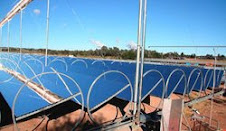
What had been the star of the world summit on sustainable energy two years ago in Johannesburg can be seen next to the highway to Pretoria.
A huge solar collector gleams in the sun on the grounds of the South African Development Bank. But the hi-tech machine has a flaw: The round disc is rarely correctly positioned, so that it usually points Earthwards, rather than towards the sun as it is supposed to do.
The solar collector, looking like some kind of monument, actually could be seen as a symbol of the application of solar energy technology in Africa. Visitors often wonder why the rooftops on a continent so greatly bathed in sunshine don't have more solar cells.
Botswana is the leader in tapping solar energy in order to heat water
"Only those people who have a lot of money can afford it," is the explanation given by David Otieno of the Kenyan environmental group Solarnet in Kenya.
He says an estimated 200 000 households do use solar power. It costs at least €500 (600 dollars) for the investment in the equipment to convert sunshine into energy - about one-half a person's average annual income in Kenya.
Otieno reports than in the neighbouring country of Ethiopia, as much solar energy is delivered in one day than Germany uses in one and a half years.
"It is above all radios, TV sets and mobile phone rechargers which are operated on solar power," he said. "But the potential for this form of energy is far from being exhausted."
This is also the view of Beate Baethke, solar energy expert for the German investment and development company DEG.
'The politicians want to protect the old state monopolies'
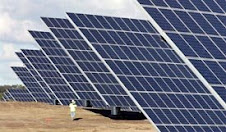
"In southern Namibia there have been measurements showing that just through the sun's radiation alone 3 000 kilowatt-hours could be produced annually per one square metre," she said. "This is several times over the levels found in California."
It is no wonder, then, that the United Nations Environment Programme (UNEP) is pushing the use of solar energy in Africa. For three years UNEP has been gathering data in the research of the continent's solar and wind power potential.
In many parts of Africa, solar energy does not even have to compete against conventional power sources as is the case in Europe. Electricity networks often do not extend beyond a city's boundaries.
"The question here is not 'solar power or coal', but rather 'solar power or no electricity?'," commented UNEP energy expert Eric Usher. In Zambia, for example, only about five percent of the population has electricity, with solar power conversion the most widely-used source.
Botswana, by contrast, is the leader in tapping solar energy in order to heat water. "There is scarcely a public building there in which the warm water has not been heated by the sun," said Usher.
In South Africa, Germany is promoting the electrification of remote regions. Under a €15,8-million loan, work began in May 2002 to provide 27 000 households, schools and health clinics with solar power.
Prior to that, the European Union had invested €12,5-million in solar energy, the aim to provide 1,000 rural schools with electricity for the first time ever. But the project suffered a setback due to theft of equipment and above all vandalism.
Professor Linda Chisolm of South Africa's national research council HSRC cites a further reason for the difficult position of solar power in Africa.
"There are indications that solar facilities are regarded as a second-class source of electricity in many rural regions, and that they are seen as too weak and too expensive while blocking the greatly-desired access to electric power grids," she said.
Besides such problems of acceptance, many experts also regard the conventional power concerns as an obstacle, and the same applies to governments' unwillingness to try out alternative energy sources.
"The politicians want to protect the old state monopolies," says Otieno of Solarnet in Kenya. "For many governments in Africa, solar energy is something suspicious."
But he says there is some hope. In Kenya, solar collectors come tax-free, and further accessories are also soon to be made exempt from taxes.
Namibia is also going down some new paths, says Beate Baethke. "There, state-recognised technicians can make applications for their customers, and then they receive subsidies," she said.
Above all, farms with no link to the Namibian electricity grid are more and more augmenting their diesel-powered generators with photovoltaic facilities.
Showing posts with label solar power in africa. Show all posts
Showing posts with label solar power in africa. Show all posts
Monday, October 22, 2007


Sunday, August 26, 2007
South Africa to invest in solar energy for water heating
By: Terence Creamer
State-owned power utility Eskom is advancing what it calls its ‘Accelerated Demand Side Management’ (DSM) programme on which it plans to spend R10-billion over the next five years in a bid to save 3 000 MW by 2012 – nearly the equivalent of a new base-load power station.
The DSM scheme, which, if successful, could help delay the introduction of new, and increasingly expensive, generation capacity, is also viewed as crucial to ensuring that South African residents and industry continue to have power during a period when Eskom will be running well below its ideal reserve margin of 15%.
The utility is currently operating with a reserve margin of between 8% and 10% and CEO Jacob Maroga has indicated that this margin could fall further in the coming five to eight years, before its first new base-load capacity begins coming on stream. He has also indicated the degree of urgency, stating that the winter of 2008 is going to be “materially tighter” than the winter of 2007, which experienced a demand peak of 36 513 MW on July 5 and had several days of operating above the 36 000-MW level.
“Next winter is going to be a far [greater] challenge,” Maroga tells Engineering News, pointing out that, despite its having approved generation-related investments of more than R204-billion for 13 000 MW, there will be a significant lag before that capacity becomes available. Indeed, the first power from the R78,6-billion Medupi station is only expected to come on in phases as from late 2011.
“We are, therefore, accelerating and intensifying our energy-efficiency initiatives, and are targeting savings of 3 000 MW at a cost of R10-billion by 2012 and 8 000 MW by 2025, which would be the equivalent of two power stations,” Maroga avers.
He tells Engineering News that some of the big DSM targets include solar-water heating, the roll-out of energy-efficiency lighting, and an enlargement of its radio and television power alert system. It will also be working with the Department of Minerals and Energy to encourage new regulations in a bid to ensure that new standards for lighting and household appliances embrace the energy-efficiency imperative.
“We are particularly keen to facilitate the scaling-up of the South African solar-water heating industry and we are doing studies to assess current capacity as well as whether we could incentivise its further development,” Maroga explains.
There will also be a drive to integrate with energy-efficiency measures being taken by municipalities, including the introduction of geyser ripple control, which could see household geysers switched off remotely in times of supply tightness.
The alert and efficient-lighting programmes, meanwhile, will be modelled, in part, on Eskom’s successful DSM roll-out in the Western Cape. This evolved during the rolling blackouts and daily load shedding that took place in the pro- vince during early 2006.
During the crisis, Eskom implemented a fast-track energy-efficiency programme, which included rolling out five-million efficient light bulbs and the innovative power alert, which is now broadcast daily on national television.
ENERGY EFFICIENCY, CLIMATE CHANGE AND CLEAN COAL
An added benefit of DSM success will be in helping South Africa achieve some of its climate-change mitigation ambitions. “This will not only assist with the capacity situation, but will also reduce environmental impacts and take costs out of the economy,” Eskom executive Dr Steve Lennon avers.
He stresses, too, that beyond diversification of Eskom’s primary-energy mix away from coal (the utility is currently 88% depend- ent on coal), it is also interrogat- ing a range of possible clean-coal solutions.
“We are looking at a range of coal-based technologies that either reduce or eliminate CO2 emis- sions.” he says, adding that underground coal gasification is a key technology in this regard.
“We are piloting the technology at Majuba. If it is successful, it will contribute to our ability to use a resource that we have in abundance without emitting CO2.” Lennon asserts, adding that underground coal gasification lends itself to precombustion extraction of CO2.
Lennon argues that it is, thus, “inappropriate” to assume that, because coal is currently a large source of CO2 emissions, it will always be regarded as a ‘dirty’ energy source.
He reveals that Eskom has a watching brief on carbon capture and sequestration programmes around the world, including programmes of the International Energy Agency and the Electric Power Research Institute.
“We are participants in the Carbon-Seque-stration Leadership Forum so that once the technology is commercially available, we can take a look at the use of that technology in South Africa,” Lennon adds.
The utility is also interrogating wind, large-scale solar power, and advanced nuclear, biomass and ocean-current alternatives. High-voltage direct current, or HVDC, transmission, and advanced energy-efficiency technologies are also under review.
“But these technologies are not going to be available overnight. Carbon capture and storage is only likely to be commercially viable in 20 years’ time. We are working with the South African government and other research entities to look at the sequestration potential in South Africa, so as to determine whether CO2 can be effectively stored,” Lennon concludes.
State-owned power utility Eskom is advancing what it calls its ‘Accelerated Demand Side Management’ (DSM) programme on which it plans to spend R10-billion over the next five years in a bid to save 3 000 MW by 2012 – nearly the equivalent of a new base-load power station.
The DSM scheme, which, if successful, could help delay the introduction of new, and increasingly expensive, generation capacity, is also viewed as crucial to ensuring that South African residents and industry continue to have power during a period when Eskom will be running well below its ideal reserve margin of 15%.
The utility is currently operating with a reserve margin of between 8% and 10% and CEO Jacob Maroga has indicated that this margin could fall further in the coming five to eight years, before its first new base-load capacity begins coming on stream. He has also indicated the degree of urgency, stating that the winter of 2008 is going to be “materially tighter” than the winter of 2007, which experienced a demand peak of 36 513 MW on July 5 and had several days of operating above the 36 000-MW level.
“Next winter is going to be a far [greater] challenge,” Maroga tells Engineering News, pointing out that, despite its having approved generation-related investments of more than R204-billion for 13 000 MW, there will be a significant lag before that capacity becomes available. Indeed, the first power from the R78,6-billion Medupi station is only expected to come on in phases as from late 2011.
“We are, therefore, accelerating and intensifying our energy-efficiency initiatives, and are targeting savings of 3 000 MW at a cost of R10-billion by 2012 and 8 000 MW by 2025, which would be the equivalent of two power stations,” Maroga avers.
He tells Engineering News that some of the big DSM targets include solar-water heating, the roll-out of energy-efficiency lighting, and an enlargement of its radio and television power alert system. It will also be working with the Department of Minerals and Energy to encourage new regulations in a bid to ensure that new standards for lighting and household appliances embrace the energy-efficiency imperative.
“We are particularly keen to facilitate the scaling-up of the South African solar-water heating industry and we are doing studies to assess current capacity as well as whether we could incentivise its further development,” Maroga explains.
There will also be a drive to integrate with energy-efficiency measures being taken by municipalities, including the introduction of geyser ripple control, which could see household geysers switched off remotely in times of supply tightness.
The alert and efficient-lighting programmes, meanwhile, will be modelled, in part, on Eskom’s successful DSM roll-out in the Western Cape. This evolved during the rolling blackouts and daily load shedding that took place in the pro- vince during early 2006.
During the crisis, Eskom implemented a fast-track energy-efficiency programme, which included rolling out five-million efficient light bulbs and the innovative power alert, which is now broadcast daily on national television.
ENERGY EFFICIENCY, CLIMATE CHANGE AND CLEAN COAL
An added benefit of DSM success will be in helping South Africa achieve some of its climate-change mitigation ambitions. “This will not only assist with the capacity situation, but will also reduce environmental impacts and take costs out of the economy,” Eskom executive Dr Steve Lennon avers.
He stresses, too, that beyond diversification of Eskom’s primary-energy mix away from coal (the utility is currently 88% depend- ent on coal), it is also interrogat- ing a range of possible clean-coal solutions.
“We are looking at a range of coal-based technologies that either reduce or eliminate CO2 emis- sions.” he says, adding that underground coal gasification is a key technology in this regard.
“We are piloting the technology at Majuba. If it is successful, it will contribute to our ability to use a resource that we have in abundance without emitting CO2.” Lennon asserts, adding that underground coal gasification lends itself to precombustion extraction of CO2.
Lennon argues that it is, thus, “inappropriate” to assume that, because coal is currently a large source of CO2 emissions, it will always be regarded as a ‘dirty’ energy source.
He reveals that Eskom has a watching brief on carbon capture and sequestration programmes around the world, including programmes of the International Energy Agency and the Electric Power Research Institute.
“We are participants in the Carbon-Seque-stration Leadership Forum so that once the technology is commercially available, we can take a look at the use of that technology in South Africa,” Lennon adds.
The utility is also interrogating wind, large-scale solar power, and advanced nuclear, biomass and ocean-current alternatives. High-voltage direct current, or HVDC, transmission, and advanced energy-efficiency technologies are also under review.
“But these technologies are not going to be available overnight. Carbon capture and storage is only likely to be commercially viable in 20 years’ time. We are working with the South African government and other research entities to look at the sequestration potential in South Africa, so as to determine whether CO2 can be effectively stored,” Lennon concludes.
Subscribe to:
Posts (Atom)
JOIN Betfair through link below, you "Choose Your Bonus!"

SEARCH Leading Alternative Energy and Ethical Investing websites

Custom Search
Research Green Energy stocks, Clean Energy investing information
Find wind power investing info online, clean energy mutual funds, geothermal stocks, solar energy investments.
Green Energy Investing Network:
Green Stocks Investing Clean Power Blog
SolarIntell.com Renewable Power Investing Website
Wind Intell.com Wind Energy Stocks Company Links
Geothermal Power Investing Public Companies
PV Intell.com Leading Photovoltaic Solar Energy Stocks
Custom Search
Green Energy Investing Network:
Green Stocks Investing Clean Power Blog
SolarIntell.com Renewable Power Investing Website
Wind Intell.com Wind Energy Stocks Company Links
Geothermal Power Investing Public Companies
PV Intell.com Leading Photovoltaic Solar Energy Stocks